
Saturday, July 1, 2017

Living with Wildlife
I'm back in Yellowstone for the summer season! I've been working with the education office the past two weeks, working with a field trip visiting the park, presenting Skype lessons to schools all over the country, and traveling to an outreach event on nearby forest service land.


http://www.today.com/money/happy-100th-birthday-national-parks-today-celebrate-exciting-series-t86901
Saturday, February 20, 2016
Gators Galore
The winter is flying by! Normally, winter in the Everglades is the dry season -- meaning little to no rain and mild temperatures. This winter however, has been exceptionally wet. January 2016 had the most rainfall since record-keeping began in 1932. As a result, the Everglades is still much wetter than normal for this time of year. Because of the high water levels, fish are more spread out than normal, and their predators are too.
According to my coworkers who've worked here for many years, the visible wildlife is a fraction of normal. Luckily for me, I have no basis of comparison, and continue to be amazed by the wildlife. Alligators especially, so I thought it was time to share some more photos.
This guy seemed to be napping and basking in the sun right on the trail. He laid there for hours. The fourth grade students I had on my field trip that day went home with a great story to tell!


I saw these two basking on the grass right near the parking lot at Shark Valley, in the northern part of the national park. They couldn't be bothered by the hundreds of visitors walking past.

I'm learning that it's not too difficult to convince northerners to visit South Florida in the winter :) I was fortunate to have my best friends from Dartmouth visit a couple weekends ago. We had a great time exploring the Everglades, and relaxing on the beach in Key Largo.

We also took a glass-bottom boat tour in John Pennekamp state park. Looking down on the brilliantly-colored fish and coral was amazing. I look forward to going out there again with a snorkel!

Sunday, January 17, 2016
"There are no other Everglades in the world"
Happy new year! I jumped into 2016 with a new job with the National Park Service, working as a seasonal education ranger at Everglades National Park. I've been here for nearly a month now, and thought I'd post some photos and reflections.

The list of differences between this park and Yellowstone is long, but one of the most profound is the surrounding population. Everglades National Park sits in Miami-Dade county, where there are roughly 350,000 students in public schools K-12. This a huge opportunity for Everglades, and the Environmental Education office is growing in attempts to reach as many students as possible.
I'm working with a new field trip program that works with 80 to 100 fourth grade students each day, Monday through Thursday, each week. There have certainly been some challenges with this new program, but I'm learning a lot and the program is getting better each day. Last week, a group of students on one of my field trips got to see an Anhinga spear a fish, fight with it for several minutes, and eventually swallow it whole. Moments like that make my job very rewarding :)


The list of differences between this park and Yellowstone is long, but one of the most profound is the surrounding population. Everglades National Park sits in Miami-Dade county, where there are roughly 350,000 students in public schools K-12. This a huge opportunity for Everglades, and the Environmental Education office is growing in attempts to reach as many students as possible.
I'm working with a new field trip program that works with 80 to 100 fourth grade students each day, Monday through Thursday, each week. There have certainly been some challenges with this new program, but I'm learning a lot and the program is getting better each day. Last week, a group of students on one of my field trips got to see an Anhinga spear a fish, fight with it for several minutes, and eventually swallow it whole. Moments like that make my job very rewarding :)

Great white egret. One of many types of wading birds seen in the sawgrass prairies and freshwater sloughs.

American Alligator. The Everglades is the only place in the world where alligators, who live in freshwater, and crocodiles, who live in brackish water, coexist.

This is the amphitheater at the Flamingo campground, looking out on Florida Bay.

On my drive home one day during my first week, I had to wait for this guy to cross the road.

Yesterday, I went canoeing in Florida Bay and saw many types of birds. This bald eagle seemed like he was posing for me. I also saw a roseate spoonbill, more brown pelicans than I could count, ibises, great blue herons, little blue herons, green herons, and of course lots of gulls.

Here's Betsy Baja in front of the Everglades National Park sign on a big brown rock, which people lovingly refer to as the potato.
"There are no other Everglades in the world. They are, they have always been, one of the unique regions of the earth, remote, never wholly known. Nothing anywhere else is like them; their vast glittering openness, wider than the enormous visible round of the horizon, the racing free saltness and sweetness of the their massive winds, under the dazzling blue heights of space. They are unique also in the simplicity, the diversity, the related harmony of the forms of life they enclose. The miracle of the light pours over the green and brown expanse of saw grass and of water, shining and slow-moving below, the grass and water that is the meaning and the central fact of the Everglades of Florida. It is a river of grass."
Marjory Stoneman Douglas, The Everglades: River of Grass, 1947
Monday, October 5, 2015
Photos from Yellowstone
It's been just over a year since I last updated this page, and it's safe to say I have some updates to share.
After finishing up my semester of student teaching at Mascoma from my last entry, I spent three weeks in classes at the Tuck Business Bridge Program, moved to the Midwest to work at a large, international healthcare software corporation, and then moved to the real West to work in the world's first National Park. Here are some photos and tidbits from the summer and fall in Yellowstone.
This spring, I accepted a job with the National Park Service as a Recreation Ranger with the Yellowstone Youth Conservation Corps (YCC) program. YCC is a work program for 15 - 18 year old students, who live and work, getting paid, in Yellowstone for four weeks. The other Professional Recreators (as we like to call ourselves) and I were responsible for supervising the students on nights and weekends. We lived in a dorm in Mammoth Hot Springs in the northern part of the park, but I led groups of students on day-long hikes and overnight backpacking trips all around the park. I also enjoyed putting on talent shows, movie nights, and the infamous Yellowstone decathlon night. Man, I wish I'd known about YCC in high school!
Here's a litte more info about the program: http://www.nps.gov/yell/learn/management/yccjobs.htm
The last week of each session, we did a "group summit" hike with all 34 students. This photo was taken on top of Mount Washburn, over 10,000 ft.

After YCC ended in the end of August, I transitioned into a position in the Education and Youth Programs Office at Yellowstone. In this role, I work with field trip groups visiting the park, teach lessons over Skype to classes from all over the world, and participate in outreach to local schools and community events. So far, I've worked at a powwow, a teachers conference, with numerous field trip groups, and a cool event called Raptor Fest in Bozeman. I'm enjoying working with such a range of students and getting to teach about Yellowstone. The park is a tremendous place for learning science, history, geography, and conservation, and it's pretty special to get to share my excitement with students.
I've been lucky to have a number of friends visit me in Yellowstone this summer and fall. Here's a photo with my Aunt Linda, taken outside the Old Faithful visitor center.


“If you have not touched the rocky wall of a canyon. If you have not heard a rushing river pound over cobblestones. If you have not seen a native trout rise in a crystalline pool beneath a shattering riffle, or a golden eagle spread its wings and cover you in shadow. If you have not seen the tree line recede to the top of a bare crested mountain. If you have not looked into a pair of wild eyes and seen your own reflection. Please, for the good of your soul, travel west.”
After finishing up my semester of student teaching at Mascoma from my last entry, I spent three weeks in classes at the Tuck Business Bridge Program, moved to the Midwest to work at a large, international healthcare software corporation, and then moved to the real West to work in the world's first National Park. Here are some photos and tidbits from the summer and fall in Yellowstone.
Here's a litte more info about the program: http://www.nps.gov/yell/learn/management/yccjobs.htm
The last week of each session, we did a "group summit" hike with all 34 students. This photo was taken on top of Mount Washburn, over 10,000 ft.

After YCC ended in the end of August, I transitioned into a position in the Education and Youth Programs Office at Yellowstone. In this role, I work with field trip groups visiting the park, teach lessons over Skype to classes from all over the world, and participate in outreach to local schools and community events. So far, I've worked at a powwow, a teachers conference, with numerous field trip groups, and a cool event called Raptor Fest in Bozeman. I'm enjoying working with such a range of students and getting to teach about Yellowstone. The park is a tremendous place for learning science, history, geography, and conservation, and it's pretty special to get to share my excitement with students.
I've been lucky to have a number of friends visit me in Yellowstone this summer and fall. Here's a photo with my Aunt Linda, taken outside the Old Faithful visitor center.

And some Dartmouth friends have visited the park as well. Here's a photo with three other Dartmouth '14s on top of Observation Peak! Gerben, far right, was a crew leader with YCC this summer.

I couldn't be happier to be living and working in such an amazing place. People call it "Wonderland" for a reason :)
Regular visitors to this page (both of 'em) have seen this quote before, but thinking about my progression through the past year, I figure it's worth including again.
“If you have not touched the rocky wall of a canyon. If you have not heard a rushing river pound over cobblestones. If you have not seen a native trout rise in a crystalline pool beneath a shattering riffle, or a golden eagle spread its wings and cover you in shadow. If you have not seen the tree line recede to the top of a bare crested mountain. If you have not looked into a pair of wild eyes and seen your own reflection. Please, for the good of your soul, travel west.”
― Daniel J. Rice, This Side of a Wilderness
Friday, September 26, 2014
September Update

Today concludes week 6 of my student teaching internship at Mascoma Valley Regional High School. This fall, I am doing 12 weeks of student teaching and working on my portfolio to complete my NH 7-12 Earth/Space science teaching certification.
I'm learning a lot. That's my sugar-coated way of saying that I have more frustrating days than successful days. I like to be challenged. I always have. This fall has allowed me to realize that not all challenges are equally solvable and not all challenges are fulfilling.
The Dartmouth part of my program - specifically the grad-level seminar that goes along with student teaching - has been disappointing. It's easier said than done, but I believe that I can have a meaningful experience student teaching despite the lack of support on the Dartmouth end. I am trying to see this as an opportunity to take initiative to push myself, a chance to direct my own learning. So far, this has been much harder than I expected. I have a lot of room to improve on that front.
I'm helping to coach the cross country team, which has been a wonderfully positive experience. It's a small team - only 6 athletes - but a great group of kids. Going to practice is a highlight of a lot of days. I'm very thankful that the team has welcomed me. I'm really proud of how hard the runners work, how supportive they are of one another, and how much each runner has improved since practice began in mid-August. I hope that I can coach again in the future - wherever I might be.
Wednesday, August 13, 2014
Goodbye Colorado!
Yesterday was my last day of the season as a park ranger at Colorado National Monument. I was incredibly lucky to have this experience and I'd like to think I made the most of it. I went on a lot of adventures this summer and met a lot of truly wonderful people. Of course, there are more things I would've liked to do, places I would've liked to see, but I ran out of weekends. I prefer to think of those things as reasons to come back :)


Here are a few highlights:
The Firsts:
• 14,000-footer - Mt. Sneffels
• Raft trip - Lower Animas river, Durango
• Mountain bike trip - Rustler's Loop, Loma
• Road Race at night - Moonlight Miles 10K
Things I won't miss:
• The heat!
Things I will miss:
• Junior rangers. Going through their activity books, presenting them with a badge, and administering the oath was a highlight of every day at the visitor center.

• Meeting park visitors from all over the world
• The beach volleyball+bar that we go to on Friday nights
• Getting to hike during work time - that's pretty hard to beat
• Having a uniform - makes getting dressed for work very easy
• Taco Tuesdays with the maintenance guys
• Grand Junction Rockies single-A baseball games
• The drive to work - check out this color-enhanced photo of my commute:
• Bighorn sheep, lizards, red-tailed hawks, snakes, and scorpions (just kidding about the last two)
• My roommate Angela:
And lastly, I am re-posting a quote that I like a lot and sums up my feelings about this summer.
“If you have not touched the rocky wall of a canyon. If you have not heard a rushing river pound over cobblestones. If you have not seen a native trout rise in a crystalline pool beneath a shattering riffle, or a golden eagle spread its wings and cover you in shadow. If you have not seen the tree line recede to the top of a bare crested mountain. If you have not looked into a pair of wild eyes and seen your own reflection. Please, for the good of your soul, travel west.”
― Daniel J. Rice, This Side of a Wilderness
Sunday, August 3, 2014
Ranger Programs
This is the Bookcliffs View Shelter where rangers lead evening programs on Friday and Saturday nights in the summer. The programs go from 7:30 to 8:30ish, just perfect to watch a colorful summer sunset.

I've led the evening program a few times this summer. We have the freedom to talk about whatever we want. After a lot of reading, I've created a three part evening program that I've developed and improved over the course of the summer.
First, I talk about general history of the monument, the important characters in its history, and early efforts to build a road. I've learned a lot about the building of Serpent's Trail - the first auto road in the monument. After that, I go into the geologic story of the canyons as it pertains to road building and because I think it's fascinating (rock nerd). Then I return to the story of the road, and go into the construction of Rim Rock Drive. I talk about FDR, the Civilian Conservation Corps, and the backbreaking labor that went into building the 23 mile road along the top of the canyons through the monument.
I've been fascinated by the CCC since I learned about the legacy of their work during a memorable ranger program at Phantom Ranch when I was in high school. I've really enjoyed researching and reading accounts of life in the CCC camps during the 1930s, going through old photographs, and meeting children of CCC enrollees. I hope that through my programs, I can spark interest in this piece of American National Parks history just like that ranger at the bottom of the Grand Canyon did for me.
Friday, August 1, 2014
14,000
Sunday, I went rafting on the lower Animas river in Durango and explored silverton.
Monday, we hiked to the summit of Mt. Sneffels at 14,157'. It was my first 14er, and fittingly we met a guy on top who has hiked all 58 of them.
Here's a few photos from the hike.
This is me hiking (scrambling) up the very steep trail. Just above this, we hiked through a 200 yard section of snow. 
I made it! Even if I wasn't quite ready for the photo...

Here's my hiking partner on the summit. I accidentally beheaded him, but still a neat pic.

The Baja at the trailhead in Yankee Boy Basin. Adventure car.

Tuesday, July 15, 2014
Traveling with the Family
Last Monday, I drove to Dillon, CO, to meet up with my aunt, who's spending the summer there. My parents and brother flew into Denver and arrived in Dillon on Monday afternoon as well. Dillon, about an hour west of Denver, has the unique combination of a beautiful lake and views of snow-capped mountains. Absolutely gorgeous. And for me, the higher elevation provided a well-needed break from the scorching heat of Grand Junction (which hit 100 twice while I was in Dillon!).
Here are some photos from Dillon.

The amphitheater where there are free concerts several times each week.

And here's the family in front of Lake Dillon.

On Tuesday, we drove scenic roads through the mountains to Boulder, where we explored the walking downtown of Pearl Street. We also walked around the University of Colorado Boulder campus. Very impressive. Here's a view of the flowers on Pearl Street.


Here are some photos from Dillon.
The amphitheater where there are free concerts several times each week.
And here's the family in front of Lake Dillon.
On Tuesday, we drove scenic roads through the mountains to Boulder, where we explored the walking downtown of Pearl Street. We also walked around the University of Colorado Boulder campus. Very impressive. Here's a view of the flowers on Pearl Street.
After that, we made the short drive over to Denver where we watched a Colorado Rockies game at Coors Field. My family went to a game there when they visited Colorado in 2009, but I was working as a camp counselor and didn't make the trip. I feel lucky that it worked out for me to join them this time around.
Our seats were unreal. We sat in the second row behind the visiting team dugout. And one of us was lucky enough to even get a ball :)
Sunday, July 13, 2014
4th of July
I had to work on the 4th of July. Before you feel bad for me, let me explain.
On July 4, 1911, Colorado National Monument's first park ranger, John Otto, climbed to the top of Independence Monument and raised an American flag, which could be seen all across the canyons of Colorado National Monument. Climbers have continued this tradition for more than 100 years. In recent years, the local search and rescue team has led the climbing trip, and park visitors gather in the canyon and at the overlook to watch. Here's a little more info about the tradition: http://www.nps.gov/colm/historyculture/freedom-flies-high.htm
Another ranger and I worked at a tent at the Independence Monument Overlook. We set up spotting scopes to watch the climbers, handed out little flags, and answered questions about the monument, the tradition, and John Otto. It was a blast watching the climbers ascend and talking with incredulous visitors. There was even a news crew from Denver that came to cover the event. I really enjoyed seeing the foreign visitors waving their American flags.
Here's a photos of our tent at the overlook.

They made it! It wasn't very windy, but you can see the flag up on top. You can see some of the steps that John Otto carved into the sandstone going up the right side to the top. Click the photo enlarge.

On July 4, 1911, Colorado National Monument's first park ranger, John Otto, climbed to the top of Independence Monument and raised an American flag, which could be seen all across the canyons of Colorado National Monument. Climbers have continued this tradition for more than 100 years. In recent years, the local search and rescue team has led the climbing trip, and park visitors gather in the canyon and at the overlook to watch. Here's a little more info about the tradition: http://www.nps.gov/colm/historyculture/freedom-flies-high.htm
Another ranger and I worked at a tent at the Independence Monument Overlook. We set up spotting scopes to watch the climbers, handed out little flags, and answered questions about the monument, the tradition, and John Otto. It was a blast watching the climbers ascend and talking with incredulous visitors. There was even a news crew from Denver that came to cover the event. I really enjoyed seeing the foreign visitors waving their American flags.
Here's a photos of our tent at the overlook.
They made it! It wasn't very windy, but you can see the flag up on top. You can see some of the steps that John Otto carved into the sandstone going up the right side to the top. Click the photo enlarge.
Sunday, June 29, 2014
Independence Monument
I went hiking in Monument Canyon, home to many of the spectacular monoliths for which Colorado National Monument is known. The most iconic is called Independence Monument, shown below. It's a red-sandstone rock tower standing at roughly 450 feet, the last piece of an ancient canyon wall that has collapsed a little at a time over the last few million years.
A little bit of history: John Otto is the guy who relentlessly pushed for Colorado National Monument to be set aside as a park in the early 1900s. Some call him a free-spirit, but most say he was a total nut. He lived in the canyons by himself for close to a decade, got married in the canyon now named Wedding Canyon (it didn't last), and sent a lot of letters to the White House arguing for this area to be protected. In 1911, President Taft officially signed for the Monument, and Otto became the park's first official custodian.
Otto created the first route up Independence Monument, carving steps and even drilling holes into which he put iron bars. The bars have since been removed for safety reasons, but the steps are still used by climbers today. Otto used to climb up with an American flag and fly it on top of the tower. The tradition has continued, and on the 4th of July the local Search and Rescue team leads climbers up with a flag and apparently people hike in to the base to watch and cheer for them. I'm looking forward to seeing it on Friday!

I happened to notice some climbers while I was eating a snack at the base of Independence. This is a picture of the climbers with my camera on maximum zoom. They are WAY up there.
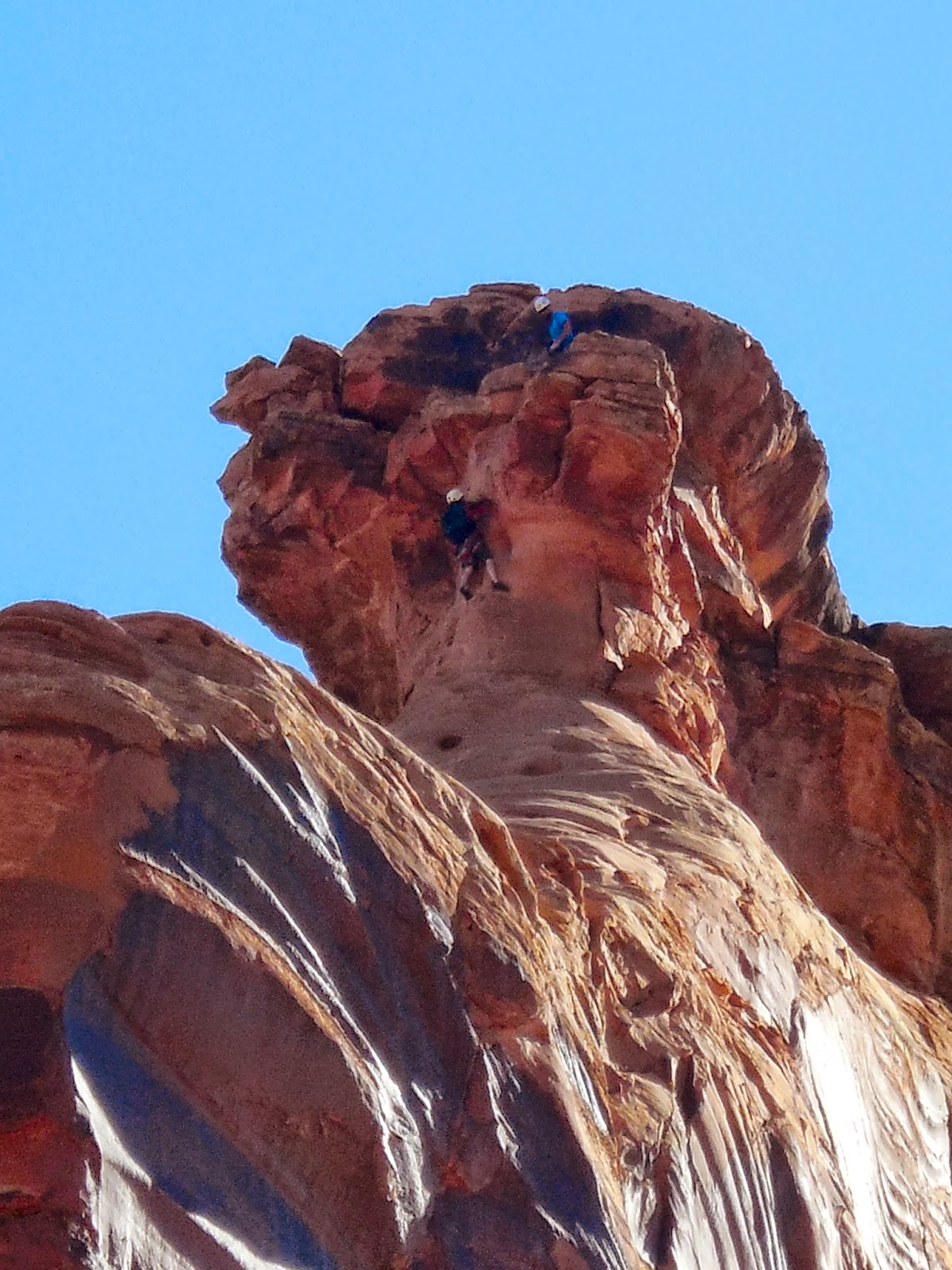
After watching for a while, I kept hiking up the canyon. Once I got up a little higher, I looked back and you could see two little tiny dots up on top. You can click on the photo to enlarge it. They made it!

Monday, June 23, 2014
Hiking on the Grand Mesa
Yesterday I drove up to the Grand Mesa, about an hour from where I live in Fruita. According to the GPS, I parked above 11,000 feet and it was all uphill from there.
I hiked the Crag Crest Trail, in the Grand Mesa National Forest. The hike was awesome - about 2 miles are along an exposed ridge where you can see many miles in every directions. Here are a few photos from my hike. You can read more about where I was here: http://www.gjhikes.com/2010/07/crag-crest-loop.html


Yes -- there were places where I had to go around snow drifts. But it wasn't cold - I hiked in shorts and a t-shirt.


I hiked the Crag Crest Trail, in the Grand Mesa National Forest. The hike was awesome - about 2 miles are along an exposed ridge where you can see many miles in every directions. Here are a few photos from my hike. You can read more about where I was here: http://www.gjhikes.com/2010/07/crag-crest-loop.html
Saturday, June 21, 2014
Canyons & Lizards!
This week was training for my role as an interpretive ranger this summer. Once I'm in the regular rotation, days will consist of giving short talks (geology talks in the morning, various presentations in the afternoon, or evening programs in the campground), staffing the information desk in the visitor center, or roving the trails to provide more informal interpretation. Yes - roving means I get to go hiking during work time.


Here are a few highlights from week one:
• Wednesday afternoon, I drove the entire park, 23 miles, along historic Rim Rock Drive, which follows the rim of the canyons. I stopped at all the overlooks, read all the signs, and talked with park visitors. In all, the drive took me about 3.5 hours. This is called Coke Ovens because the rocks have eroded to look like the dome-shaped ovens used to turn coal into coke in the olden days.
• I helped with the kids program that comes to visit the monument on Thursday mornings. The kids are part of a day camp at local elementary schools. Their program included learning about what the park service does, why Colorado National Monument was set aside to be preserved, and a short hike to Devil's Kitchen. I really enjoyed hanging out with the kids and look forward to doing it again in future weeks. This is the picnic area where the kids program meets.
• After the kids left to go back to camp, I stayed and hiked some of the east-side trails. So far, my favorite is a trail called No Thoroughfare Canyon. The trail follows a dry stream bed to a (dry) waterfall. The trees in the canyons are so cool - they are well adapted for the desert, and they need to be. The monument only gets about 9 inches of precipitation per year. Compare that to the +/- 140 inches of precipitation each year in Hanover.
Here's the waterfall.
And here's one of the many colorful lizards I spotted along the trail. There are two kinds of lizards in the monument. This one is a Collared lizard, as you can tell by the incredible colors around his neck.
• Thursday night I went to the weekly outdoor concert on the green in Fruita, just three blocks from where I'm living. Hundreds of people were there listening to the band -- pretty cool!
• Last night, I co-led the evening ranger program in the campground. For my segment, I told the story of how Rim Rock Drive was built almost entirely by hand by men in FDR's Civilian Conservation Corps between 1933-1942. I enjoyed researching it and learned a lot about the history of the monument. You can read about the road here: http://www.nps.gov/colm/planyourvisit/scenic-rim-rock-drive.htm
After work, I met some of the seasonal rangers and other GeoCorps interns at a bar/restaurant in Grand Junction that has sand volleyball courts. Sounds goofy, but it was a lot of fun.
I'm off to see a Grand Junction Rockies game, then going hiking tomorrow morning!
Subscribe to:
Posts (Atom)